
May 20, 2026
Sweden 2026-2027: A housing market between recovery and global uncertainty
How do Crowdster see the housing market in the light of the economi, trends and global uncertainty. Stay away or give it a try?
May 20, 2026
How do Crowdster see the housing market in the light of the economi, trends and global uncertainty. Stay away or give it a try?
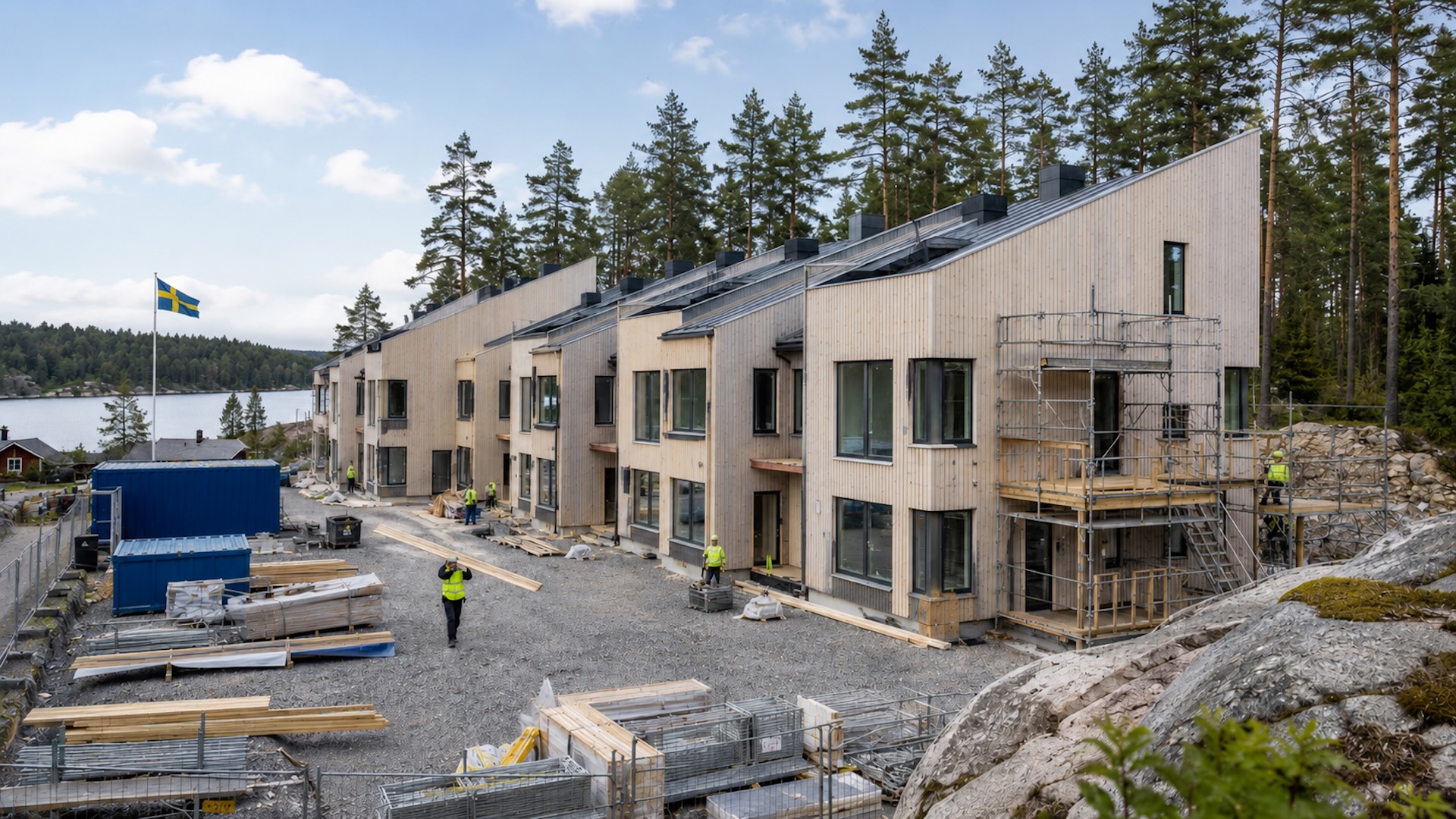
The Swedish housing market is facing a decisive transition. After several years marked by rising interest rates, inflation, and an almost historic decline in new construction, the market is now cautiously moving toward a new equilibrium. However, this recovery will not resemble previous upswings. Instead, a picture is emerging of a market where uncertainty becomes a permanent part of reality, and where resilience matters more than aggressive growth.
This is precisely why many analyses suggest that detached houses and townhouses could become some of the strongest housing segments in Sweden in 2026 and 2027.
It is not only about demand. It is about which types of housing are best suited to a new economic reality.
In the years leading up to 2022, the housing market was largely driven by cheap capital, low interest rates, and expectations of continued growth. Many projects were developed according to a logic of volume and rapid expansion. That era is over. Today, developers, investors, and lenders operate in a market where the world surrounding the housing sector has become far more unpredictable.
Geopolitical instability now plays a much larger role in housing economics than previously experienced. The war in Ukraine, tensions in the Middle East, trade conflicts, and unstable energy markets are creating ongoing uncertainty around inflation and interest rates. Oil prices, in particular, are becoming a decisive factor. If energy prices rise significantly again, inflation could quickly increase and force central banks to keep interest rates higher for longer.
This is critical for the housing market. High interest rates affect not only buyers’ finances but also the entire foundation of development projects. Financing becomes more expensive, capital is tied up for longer periods, and overall risk increases. This is especially problematic for large and complex apartment developments, where project timelines are long and financial models are more sensitive to interest-rate fluctuations.
This is where the small-house segment begins to appear significantly more attractive.
Detached houses and townhouses fit much better into the new market logic in many ways. They can often be developed in smaller phases, require less complexity, and allow developers to continuously adjust project pace according to market conditions. At the same time, demand is more stable because these housing types appeal to a broad target group of families who continue to prioritize space, flexibility, and privacy.
There are strong indications that the pandemic permanently changed housing preferences. Many families no longer necessarily want to live as centrally as possible if the alternative is small and expensive apartments. Instead, interest is growing in homes with more space, home-office possibilities, and private outdoor areas. This creates new opportunities in commuter municipalities and regional growth areas around Stockholm, Gothenburg, and Malmö.
Townhouses, in particular, stand out as especially interesting in the current situation. They offer something many households are seeking right now: a balance between affordability and quality of life. For many families, detached houses have become too expensive, while apartments no longer meet their need for space and flexibility. Townhouses position themselves between the two and therefore become an attractive compromise in a more price-sensitive market.
At the same time, industrialized construction is becoming an increasingly important part of the solution. Sweden already has a strong position in timber construction, prefabrication, and modular production, and the detached-house and townhouse segments are particularly well suited to standardized building methods. In a time of uncertain material markets and volatile energy prices, control over production and construction timelines becomes crucial.
The faster projects can be completed, the lower the exposure to rising interest rates and inflation. As a result, many developers are expected to focus much more on standardized housing types, efficient production, and energy-efficient solutions. Sustainability is increasingly not only about climate and green branding but also about economic resilience. Energy-efficient homes become more attractive as households pay closer attention to operating costs.
However, although most analyses point toward a gradual improvement in the market in 2026 and 2027, optimism remains cautious. No one expects a rapid boom like in previous years. On the contrary, there is growing recognition that the market will likely move in a more uneven pattern, with periods of progress interrupted by new uncertainties. Inflation could return faster than expected, energy prices could rise again, and the global economy could quickly change direction.
This means that the winners of the future housing market will not necessarily be those who build the most, but those who are best at managing uncertainty.
For developers, flexibility, cost control, and risk management will become essential capabilities. Projects must be adaptable, built more efficiently, and aimed at a broader target group with realistic price levels. This strongly favors detached houses and townhouses, which appear both financially and operationally more resilient than many traditional large-scale urban developments.
As a result, the small-house segment may very well become the most important driving force behind Sweden’s housing recovery in 2026 and 2027. Not because the market will necessarily become strong and stable, but because these housing types appear best equipped for a world where uncertainty has become the new normal.
.svg)